
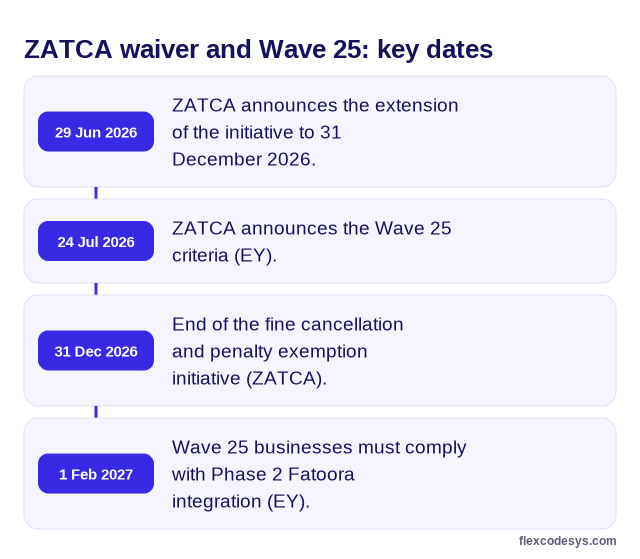
The ZATCA penalty waiver, the Zakat, Tax and Customs Authority (ZATCA) initiative to cancel fines and exempt penalties, ends on 31 December 2026 according to ZATCA's announcement of 29 June 2026. That leaves Saudi SMEs only a few weeks to deal with late returns and unpaid tax for returns that were due on or before 30 June 2026.
FlexCode Middle East is part of FlexCode Systems GmbH, an Odoo Silver Partner. We implement Odoo, and our own apps are mentioned where they fit.
Key points
- ZATCA announced on 29 June 2026 that its fine cancellation and penalty exemption initiative runs to 31 December 2026, for taxpayers under all tax laws.
- The waiver covers late registration, late payment, late filing and VAT return correction fines for returns due on or before 30 June 2026, if all returns are filed and the principal tax is paid or put on an approved instalment plan.
- It is unclear whether e-invoicing violations are still covered, because the 29 June 2026 extension excludes fines under Article 45 of the VAT Law and tax evasion fines.
- In Odoo, the ZATCA mode is set in the Accounting settings and each sales journal is onboarded separately, so check that no journal was left out.
- If your VAT-taxable revenue went above SAR 187,500 in any year from 2022 to 2025, the Wave 25 Fatoora integration deadline is 1 February 2027.
This article explains what is known about the waiver, why its scope is less clear than it looks, what to check in your VAT and e-invoicing records, and how to run those checks in Odoo. It is not tax advice: the final decision is yours and your tax adviser's.
What is the ZATCA penalty waiver and when does it end?
The initiative lets taxpayers settle their position while certain fines are cancelled or waived. ZATCA announced on 29 June 2026 that the Minister of Finance extended it for six months from 1 July 2026, so to 31 December 2026. It applies to taxpayers under all tax laws, not only VAT: KPMG lists corporate income tax, withholding tax, VAT, excise tax and real estate transaction tax. AmalERP's guide to e-invoicing in Saudi Arabia, which says it was last reviewed on 15 November 2026, reports the same date.
According to the ZATCA announcement, the waiver covers fines for late registration, late payment and late filing and the fine for correcting a VAT return, for returns that were due on or before 30 June 2026. To qualify you must be registered, file all outstanding returns and pay the principal tax in full, or request an instalment plan during the initiative and pay every instalment on time. Not covered: fines linked to tax evasion, fines under Article 45 of the VAT Law, fines already paid before the initiative, and fines tied to returns due after 30 June 2026.
The date has moved before. An older RTC Suite article said the waiver would end on 30 June 2026, with full enforcement from 1 July 2026. The extension came after that. Do not plan around another one: ZATCA states that any further extension would not cover fines tied to returns due after 30 June 2026. Check the deadline and the eligibility conditions directly on zatca.gov.sa and in your ZATCA portal account.
Does the ZATCA waiver cover e-invoicing fines?
This is the key question. ZATCA's announcement for the previous round (1 January 2026, running to 30 June 2026) expressly listed fines for e-invoicing field-inspection violations. The 29 June 2026 extension no longer mentions them and excludes fines under Article 45 of the VAT Law, which, as AmalERP notes, several advisers read as the article e-invoicing fines fall under. The result: the available sources do not make clear whether all e-invoicing violations are still covered.
Note: Do not assume every fine on your account is covered. Read Article 45 of the VAT Law in the official text, review the fines recorded against your business in the ZATCA portal, and agree with your tax adviser what can be settled before 31 December 2026.
What to check in your VAT records before 31 December 2026
The goal is to know your full position early, so there is still time to file returns or corrections if you decide to. Work through this list:
- Log in to the ZATCA portal and export the list of fines and violations recorded against your business.
- Read the official extension text on zatca.gov.sa: conditions, what is included and what is excluded.
- List every return (VAT and other taxes) due on or before 30 June 2026 that is unfiled or was filed late.
- Work out the unpaid VAT due for each period.
- Compare the tax report in your system with what you actually filed for each period, and note any differences.
- Review invoices, credit notes and debit notes that were not sent to Fatoora or were rejected.
- Decide with your tax adviser whether correcting now is better than waiting, and set an internal deadline before mid-December.
ZATCA e-invoicing rules your system must meet
Clearing up the past is not enough if your system still allows new violations. FBS Advisory's Wave 25 guide summarises the requirements for an e-invoicing solution. These are the main ones. The Odoo column is our own suggestion of where to look, not an official mapping:
| Rule | Why it matters | Where to check in Odoo |
|---|---|---|
| The invoice counter cannot be reset | An unbroken sequence shows your records are complete | Sequence of the sales journals in the journal settings |
| The system date cannot be changed to back-date invoices | The date is part of the invoice data sent to ZATCA | User access rights and server settings |
| Issued invoices cannot be deleted or edited | Corrections are made with a credit or debit note | Control over resetting documents to draft |
| Each user has their own login | Every action can be traced to one person | Settings: Users and Companies |
| XML files are stored and logs cannot be altered | Proof of what was sent to ZATCA | Chatter and attachments of each invoice (per the Odoo documentation) |
Keep the submission model in mind too. According to Out2Sol and EDICOM, standard B2B tax invoices are cleared in real time, while simplified B2C invoices must be reported within 24 hours. Out2Sol adds that invoices carry a cryptographic stamp and a unique identifier (UUID), and that the solution connects to Fatoora with cryptographic stamp identifiers (CSIDs). FBS Advisory also lists that cryptographic keys must not be exportable.
For context: ZATCA announced the Wave 25 criteria on 24 July 2026, with Governor Decision No. 1448-99-238 published in the Official Gazette that day, according to EY. It is the first wave to count calendar year 2025 revenue. As of 4 October 2026, einvoice.global reported no wave announced after Wave 25.
How the year-end review works in Odoo
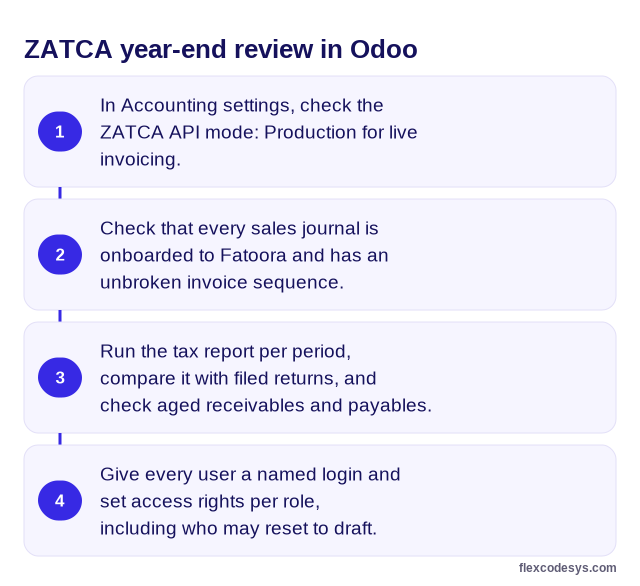
Odoo's Saudi localisation includes the Saudi chart of accounts and taxes and a ZATCA e-invoicing module. Menu names differ slightly between Odoo versions, so check each path in the version you run. A typical review follows these steps:
Onboarding and journals
According to the Odoo documentation, the ZATCA API mode (Sandbox, Simulation or Production) is set once in the Accounting settings. Onboarding is then done per sales journal: on the journal's ZATCA tab you click Onboard and enter a one-time password (OTP) from the Fatoora portal. Each sales journal must be onboarded separately, so a journal that was never onboarded is an easy mistake to miss. Once the mode is Production and an invoice has been submitted, it cannot be switched back to Sandbox or Simulation.
VAT figures and open items
Run the tax report for each period and compare it line by line with the returns you filed. The aged receivable and aged payable reports help you find old open items that may hide unbilled or uncorrected transactions. According to the Odoo documentation, invoices successfully submitted to ZATCA can only be reset to draft in the Sandbox or Simulation modes, so in Production corrections go through credit or debit notes.
Users and rights
Shared logins break traceability. Give everyone a named user. If too many people can reset posted documents to draft, the FlexCode app Posted Document Control restricts reset to draft per user and keeps an audit log. For role-based rights across larger teams, Access Profiles groups permissions by role. If you need help setting up the Saudi localisation, see our Odoo Accounting service.
What Saudi businesses should do now
- Confirm on zatca.gov.sa and in your portal account which fines you have and whether the waiver covers them.
- Finish your list of unfiled returns, unpaid VAT and corrections this week, not in the last week of December.
- Agree the next steps with your tax adviser.
- Check the e-invoicing rules in the table above in your system.
- If your VAT-taxable revenue exceeded SAR 187,500 in any year from 2022 to 2025, plan Fatoora integration testing now for 1 February 2027.
Settle what the waiver may still cover before 31 December 2026, then make sure your system cannot create the same problems again.
If you want a second pair of eyes on your Odoo setup, book a free 30-minute ERP check through our contact page. We review your Saudi localisation, journals and user rights with you.
Frequently asked questions
Does the ZATCA penalty waiver also cover Zakat?
ZATCA's announcement speaks of all tax laws, and KPMG lists corporate income tax, withholding tax, VAT, excise tax and real estate transaction tax. Zakat is not named in either, so check the official initiative text on zatca.gov.sa or ask ZATCA directly.
ZATCA has not contacted us about Wave 25. Are we still affected?
Wave 25 is defined by revenue: according to FBS Advisory and EY, VAT-taxable revenue above SAR 187,500 in any one year from 2022 to 2025 puts a taxpayer in scope. KPMG reports that ZATCA notifies the taxpayers it targets. If you are unsure, check your own figures and ask ZATCA rather than assuming you are out of scope.
Can we still file corrections after 31 December 2026?
Corrections can still be needed and filed later, but the penalty relief is tied to the initiative's end date, and ZATCA states that any further extension would not cover returns due after 30 June 2026. After 31 December 2026, fines may apply in full. Confirm the rules with your tax adviser.
Do receipts from Odoo Point of Sale count as simplified invoices?
Sales to consumers are typically issued as simplified B2C invoices, which must be reported to ZATCA within 24 hours according to Out2Sol. According to the Odoo documentation, Point of Sale needs the Saudi Arabia - E-invoicing (Simplified) module and its invoice journal must be onboarded. Test in Simulation mode before going live, because the mode cannot be switched back once an invoice has been submitted in Production.
This article is also available in: العربية
FlexCode configures Odoo for your business
We fit the system to your workflows and train your team. FlexCode Middle East in Cairo, part of an Odoo Silver Partner.