This article gives general information and is not tax or legal advice. Rules can change; check your case with your tax advisor.
On 15 October 2026, Germany's Federal Ministry of Finance (Bundesministerium der Finanzen, BMF) published the third BMF e-invoice letter, with additional rules on mandatory e-invoicing. It adds rules on how goods and services must be described, on attachments, on final invoices after down payments, on corrections and on validation errors. E-invoices that do not meet these new rules are only tolerated until 31 December 2026.
FlexCode Systems is an Odoo Silver Partner in Germany. Odoo appears throughout this article because it is the system we implement, alongside an honest look at the problem it solves.
Key points
- The third BMF e-invoice letter of 15 October 2026 adds to the 2024 and 2025 letters; it does not replace them.
- E-invoices that miss only the new additional rules are tolerated until 31 December 2026, including for the buyer's input VAT deduction.
- The tax-relevant description of goods or services must sit in the structured XML, not only in the PDF or an attachment.
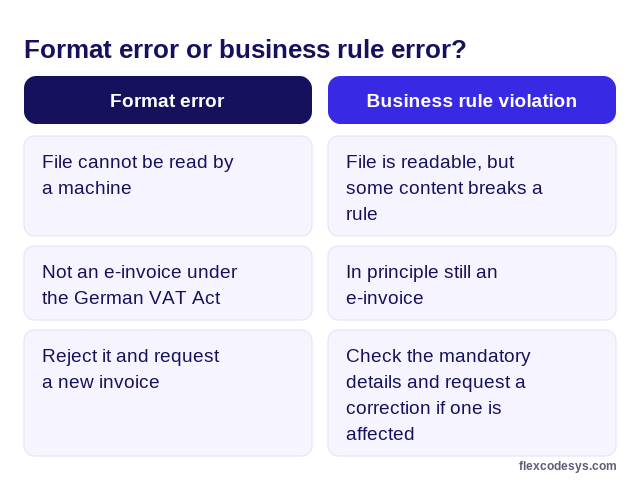
- A file without format errors remains an e-invoice in principle even if it breaks a business rule, but its mandatory details must still be correct and complete.
- In Odoo, check line descriptions, down payment deductions on final invoices and credit notes that reference the original invoice.
If you run Odoo, use the coming weeks to check what actually ends up in the XML file of your invoices. The rules apply to domestic B2B sales in Germany. Companies in other countries, for example Austria or Switzerland, are affected only if they have a German entity or German customers who ask for invoices that follow these rules.
What does the third BMF letter on e-invoicing cover?
The BMF letter of 15 October 2026 is titled "Ergänzende Regelungen" (additional rules) and is published in the Federal Tax Gazette as BStBl 2026 I p. 1200. It amends the UStAE, the administrative guidance German tax offices follow when applying the VAT Act. According to EY, the changes mainly affect sections 14.1, 14.5, 14.11 and 15.11. The earlier letters of 15 October 2024 and 15 October 2025 remain in force. What is new, as Baker Tilly points out, is that the tax authorities now name individual Business Terms (BT) of the European standard EN 16931.
When does the e-invoicing grace period end?
According to analyses by EY, PwC and Ebner Stolz, e-invoices issued up to 31 December 2026 that meet the 2024 and 2025 letters will not be challenged, even if they miss the new additional rules. This protection also covers your customer's input VAT deduction. On the same date, as Haufe reports, the general transition rule expires. Under that rule, every company may still bill supplies made up to the end of 2026 with other invoice types: paper or, if the customer agrees, a plain PDF. According to Haufe, companies whose total turnover in 2026 was no more than EUR 800,000 may still do so for supplies made up to 31 December 2027.
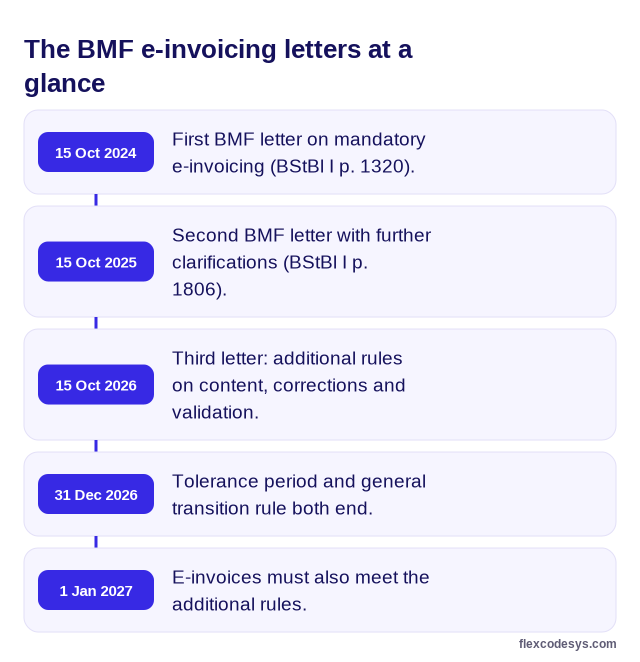
Note: According to BDO and Ebner Stolz, the BMF confirms that issuing another invoice type where an e-invoice is required is not an administrative offence under § 26a(2) no. 1 of the German VAT Act. The e-invoicing obligation still applies, and your customers may still face problems with their input VAT deduction.
What are the new e-invoice requirements?
The table sums up the points that create the most work for Odoo users. Some details come only from law firm and specialist summaries, so ask your tax advisor to confirm them against the original letter.
| Topic | What the BMF letter says | What to check in Odoo |
|---|---|---|
| Description of supply | Type, scope and, where needed, place of the supply stated in the XML clearly enough to serve the control function (BMF letter, para. 12) | Line labels, product descriptions, quotation templates |
| Attachments | Additional details may go in an embedded attachment; mandatory details belong in the XML (NWB) | Whether extra documents are embedded in the file |
| Final invoice | Deduction of paid down payments, according to rechnex.de also via BT-113 with details in BT-22 | How negative down payment lines appear in the XML |
| Correction | Where an e-invoice is mandatory, the correction must be an e-invoice too; with prior agreement the customer may correct by self-billed credit note. The invoice type for corrections is not yet technically defined (BMF letter, para. 20) | Reference to the original invoice on the credit note |
| Validation errors | Without a format error the file remains an e-invoice in principle, even if it breaks a business rule; the mandatory details must still be correct and complete (BMF letter, para. 23) | Accounts payable process for incoming invoices |
Line descriptions and attachments
The BMF recommends the mapping table published by KoSIT and FeRD, the German bodies behind XRechnung and ZUGFeRD, which assigns each mandatory invoice detail to a Business Term or Business Group. In practice, generic line labels such as "flat fee" or "see attachment" are unlikely to meet the control function. The description has to be in the structured part. An embedded PDF or timesheet can add detail, but it cannot replace it.
Final invoices and corrections
According to rechnex.de, the letter allows paid down payments to be deducted via BT-113, with details in BT-22 or an attachment, until 30 June 2030. Down payment invoices issued before your own e-invoicing obligation started do not have to be e-invoices. For corrections, finisma.de explains: if the original invoice had to be an e-invoice, the correction must be one too. With prior agreement, your customer may also correct an e-invoice with a self-billed credit note, as long as it clearly references the original invoice. The letter itself names no type code and says the invoice type for corrections is not yet technically defined; Baker Tilly names code 389 for the self-billed credit note.
How to check and fix e-invoices in Odoo
According to the Odoo documentation, Odoo Accounting creates XRechnung (UBL) and ZUGFeRD/Factur-X (CII) files. You set the format per customer on the Accounting tab of the contact; general settings are under Accounting > Configuration > Settings. The invoice line label is written into the XML, so fix problems at the source: the product's sales description, the sales order line, or the lines generated from timesheets. Menu paths can differ slightly between versions, so check them in your own database.
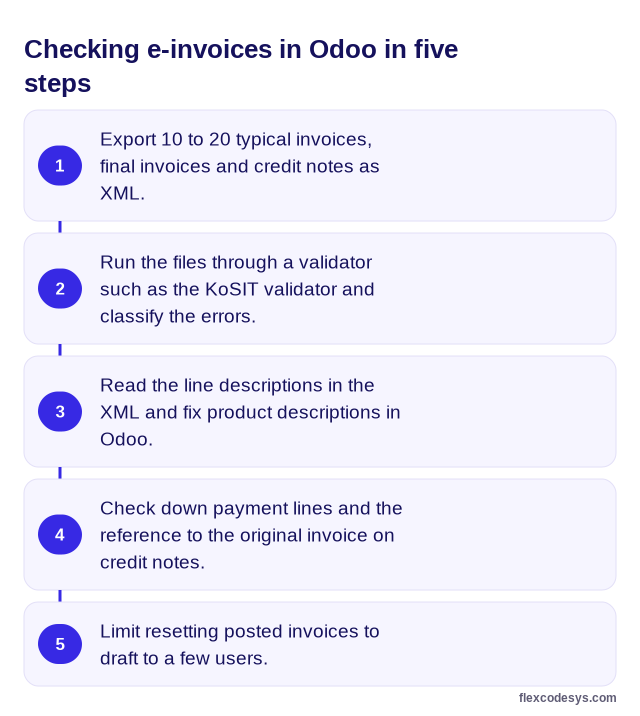
For down payments, Odoo's Sales down payment flow deducts the invoiced down payments as negative lines on the final invoice. Make sure only amounts you have actually received are deducted, because the BMF rule refers to payments received. Look at how these lines appear in the XML and decide with your tax advisor whether that is sufficient. Odoo creates credit notes linked to the original entry; check that the reference to the original invoice (BT-25) is in the file. Check in your version whether the invoice PDF is embedded in the UBL file. If you also need delivery notes or timesheets embedded, a custom module may be required.
Incoming XRechnung and ZUGFeRD files can usually be imported as vendor bills by upload or through an email alias; test this with sample files in your version. According to the Odoo documentation, the Factur-X format enables validation checks on the invoice. For a full check against EN 16931 we recommend an external validator, which you can automate, for example with n8n. To make sure sent e-invoices are corrected with a traceable correction document instead of being changed afterwards, the FlexCode app Posted Document Control controls who may reset posted invoices to draft.
For an e-invoice, what counts is not what your PDF shows, but what the XML file of your invoice contains.
Checklist: review your e-invoices before 31 December 2026
- Export and validate typical outgoing invoices as XML: standard sale, service, final invoice, credit note.
- Sort the findings into format errors and business rule errors.
- Replace line labels such as "flat fee" or "see attachment" with specific descriptions.
- Agree with your tax advisor how final invoices deduct down payments.
- Check that credit notes contain the original invoice number in the XML.
- Agree self-billed credit notes with customers in advance, ideally in writing.
- Define the rule for incoming invoices with your tax advisor: reject format errors, and for business rule errors check whether a mandatory detail is affected before you post.
- In mass business with ongoing contracts and mixed customers, record at contract start or change whether the customer is a business.
- Restrict resetting posted invoices to draft.
What to do now
Schedule the review for the coming weeks, while the grace period still runs. Start with the invoice types you issue most often, and involve your tax advisor early on final invoices and credit notes. Help with the setup is described on our Odoo Accounting page.
If you are unsure whether your Odoo invoices meet the new requirements, book the free 30-minute ERP check or reach us through the contact page. If your system was set up by another partner, we offer an audit for EUR 990 plus VAT.
Frequently asked questions
Do I need to upgrade to a newer Odoo version because of the new BMF letter?
Not necessarily. Most points concern content such as line descriptions, down payment lines and references, which you can check and adjust in your current version. An upgrade is only worth it if your version does not generate the required XML format correctly.
Can I keep using ZUGFeRD instead of XRechnung?
Yes. ZUGFeRD from version 2.0.1 and XRechnung are both accepted formats; according to Lexware, only the ZUGFeRD profiles MINIMUM and BASIC-WL are not sufficient. What matters is that the structured part contains all mandatory details. Agree the format with your main customers and set it per contact in Odoo.
How long do I have to keep e-invoices?
Since 1 January 2025, the retention period for accounting vouchers in Germany is 8 years under the Fourth Bureaucracy Relief Act (BEG IV). You must keep the e-invoice in its original format, meaning the XML file. Confirm the details with your tax advisor based on § 147 of the German Fiscal Code (AO).
Does the letter apply to companies outside Germany?
Only indirectly. The rules apply to supplies between businesses established in Germany. You are affected if you have a German company or permanent establishment, or if German customers ask for e-invoices that follow these rules.
This article is also available in: Deutsch
FlexCode configures Odoo for your business
We fit the system to your workflows and train your team on every module. Odoo Silver Partner, based in Germany.