
Short answer: none of the three SEPA structured address deadlines announced for November 2026 took effect as planned. The European Payments Council (EPC) removed the end date for unstructured addresses from its guidance on 30 September 2026, Swift deferred its address change for cross-border payments on 27 August 2026, and the German banking industry suspended the retirement of old file formats such as pain.001.001.03. The only change that did take effect is version 26.11 of the German data format specification. Individual banks may still switch off formats on their own schedule, so ask your bank.
FlexCode Systems is an Odoo Silver Partner in Germany. Odoo appears throughout this article because it is the system we implement, alongside an honest look at the problem it solves.
Key points
- The EPC removed the 15 November 2026 end date for unstructured SEPA addresses on 30 September 2026 and has not set a new one.
- Swift deferred the removal of unstructured addresses from cross-border CBPR+ payments on 27 August 2026.
- Version 26.11 of the German DK data formats took effect in November 2026, but the retirement of pain.001.001.03, pain.008.001.02 and DTAZV is suspended.
- Individual banks may still switch off formats or reject addresses, so ask your bank and submit a test file.
- Odoo creates pain.001.001.09 by default, and the version is chosen per bank journal in the XML Format field.
If you create payment files in Odoo, that means three things: check the file format, keep your vendors' addresses structured, and test the upload with your bank. This article sorts out which change applies to which payment.
Three changes that often get mixed up
Many bank pages and consultancy blogs lump three separate rule sets together. They cover different payments and are at different stages:
| Rule set | Applies to | Status at end of November 2026 |
|---|---|---|
| EPC guidance on addresses (SEPA) | SEPA Credit Transfer, SEPA Instant, SEPA Direct Debit | End date of 15 Nov 2026 withdrawn on 30 Sep 2026, new date to follow |
| German DK data formats, version 26.11 (DFÜ agreement, Annex 3) | Files you send to German banks | Version 26.11 in force since November 2026; planned retirement of pain.001.001.03, pain.008.001.02 and DTAZV suspended, no new end date |
| SWIFT CBPR+ | Cross-border payments outside SEPA | Removal of unstructured addresses (planned for 14 Nov 2026) deferred on 27 Aug 2026, no new date yet |
What the EPC changed on 30 September 2026
The original plan was to allow only structured or hybrid addresses in all EPC schemes from November 2026. Version 2.1 of the EPC guidance on the provision of addresses named 15 November 2026, and as late as June 2026 the EPC confirmed that date to the ERPB, the euro payments board chaired by the ECB. Version 2.2 of 30 September 2026 removed the date. A new one will follow based on market and industry developments. On the same day the EPC published version 1.2 of all five 2025 SEPA rulebooks.
One detail matters here: according to the EPC, the hybrid address has no expiry date. Even so, the EPC recommends moving straight from unstructured to fully structured addresses, with street, building number, postcode, town and country each in its own field.
Note: Some banks still state on their websites that unstructured SEPA addresses have been rejected since November 2026. Whether banks actually do this despite the EPC postponement could not be confirmed in general. Ask your bank exactly what it rejects.
pain.001.001.09 and DK version 26.11: what German banks expect
If you pay through a German bank, a separate change applies. Independently of the EPC, the German banking industry (Deutsche Kreditwirtschaft, DK) has updated its data formats. Since November 2026, version 26.11 of Annex 3 to the DFÜ agreement applies; the version number now shows year and month (the previous one was 3.9), as SozialBank explains. The retirement of the old formats pain.001.001.03, pain.008.001.02 and DTAZV (the old German format for foreign payments), planned for November 2026, has been suspended: according to the DK's format lifecycle page, they stay in operation temporarily and no new end date has been set. That does not bind every bank. Individual banks may still stop accepting old formats on their own schedule, so ask your bank whether it still accepts your current format.
A common reason for a rejected payment file is the variant within pain.001.001.09. The older German variant GBIC_4 only allowed fully structured addresses; hybrid addresses became possible with GBIC_5, according to banking-connector. According to SozialBank, the German standard has accepted hybrid addresses in SEPA files since October 2025 and in international payments since November 2025. For many SEPA payments within the EEA, the address is not even mandatory.
Cross-border payments over SWIFT: deferred, not cancelled
For cross-border payments outside SEPA, the November date has moved as well. Swift had planned to remove unstructured postal addresses from the CBPR+ standard with the November 2026 release and to reject such messages. On 27 August 2026, Swift accepted a community request and deferred this change. A new date for the address rule had not been confirmed when this article was written. The requirement itself is unchanged: town and country in their own fields, fully structured preferred, hybrid allowed. Bank statements and notifications (camt.052, camt.053, camt.054) were outside the scope of the change anyway, so your bank reconciliation is not affected.
Payments to non-SEPA countries and in foreign currencies, for example to suppliers in Egypt, the Gulf or the US, are the ones the Swift rule covers, so start with those suppliers' master data. For SEPA payments that involve a bank in a non-EEA SEPA country, such as Switzerland or the United Kingdom, the EPC guidance (version 2.2, footnote 1) makes the country in the payer's address mandatory. That is your own company address, not the supplier's, so check it in Odoo as well.
How to check your payment files in Odoo
According to the Odoo 20 documentation, Odoo creates SEPA XML files in pain.001.001.09 by default, and you choose a different version on the bank journal (Accounting, Configuration, Journals): open the Outgoing Payments tab and use the "XML Format" field. The file is generated from a batch payment and attached in the chatter for download. If you upgraded from an older version or set the option manually in the past, check each bank journal separately.
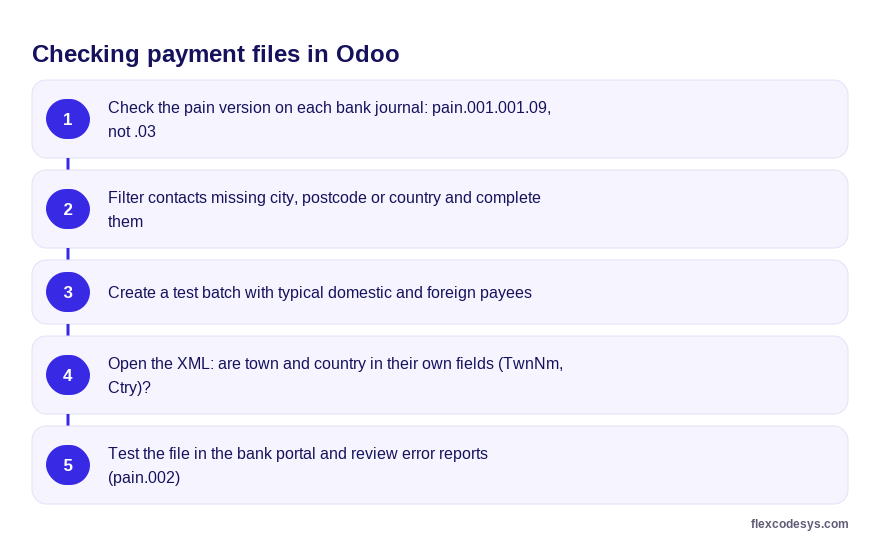
For step 2, a filtered list of the vendors you pay is enough. Typical errors are a full address typed into the street line, a missing country, or the city in the wrong field. How Odoo maps contact fields to XML elements, and whether it writes a hybrid or fully structured address, can vary by version and installed modules. That is why looking at the generated file in step 4 matters. If you need to split many addresses, for example street and building number, an automated cleanup through custom modules and imports can save a lot of manual work.
Odoo Community with OCA modules
With the OCA module account_banking_sepa_credit_transfer, Odoo no longer builds the old unstructured address block for pain.001.001.09. You set the "PAIN.001.001.09 Address Mode" on the payment method. If you leave it empty, the module uses the Minimal mode, which writes only town (TwnNm) and country (Ctry). For street lines you need the Hybrid mode.
Switzerland
Swiss banks use their own variant under SIX rules, pain.001.001.09.ch.03. In Odoo Community, the OCA module l10n_ch_pain_credit_transfer supports this format. In other countries, including Austria, the EPC and SWIFT rules apply in the same way; clarify any national specifics directly with your bank.
What to do now
- Every bank journal produces pain.001.001.09 (or the Swiss variant); bank asked how long it still accepts .03 and DTAZV
- Vendors you pay abroad have city, postcode and country code in separate fields
- Own company address complete with town and country (payments to Switzerland and the UK); payees in non-SEPA countries checked first
- Test file submitted to the bank and pain.002 responses reviewed
- Bank asked: does it reject unstructured SEPA addresses, and which GBIC version does it expect?
- On Odoo Community: address mode checked on the payment method (Minimal is the default, Hybrid adds street lines)
- Target set: fully structured addresses for all new contacts
The deadlines are postponed, not cancelled: structure your addresses now and the next dates will require no work.
Cleaning up addresses still makes sense even though the EPC and Swift moved their dates. Both have said new dates will follow, and your bank may be stricter than the standard. If you are unsure whether your Odoo setup fits, we can help through our Odoo accounting services or post-go-live support. A good starting point is the free 30-minute ERP check, which you can request on our contact page.
Frequently asked questions
Does the address change also affect SEPA direct debits?
Yes, the EPC guidance covers all EPC schemes, including SEPA Direct Debit, and the end date for unstructured addresses was withdrawn there too on 30 September 2026. The planned retirement of the old direct debit format pain.008.001.02 under the German standard is suspended as well, but ask your bank how long it will still accept it.
How do I find out why my bank rejected a payment file?
Banks usually return a status report in pain.002 format or a message in the bank portal. It contains error codes that point to the affected field or format. Common causes are a pain format your bank no longer accepts, an unsupported GBIC variant, or missing town and country details.
Do I have to update all existing contacts at once?
Not necessarily. The EPC and Swift deadlines are currently on hold. Start with vendors you pay through SWIFT outside SEPA, because the Swift change is only deferred, and check your own company address for payments to SEPA countries outside the EEA. Then work through the remaining payees so you are ready when the new dates are set.
What does it cost to have FlexCode check my Odoo system?
The 30-minute ERP check is free. If another partner set up your system, we offer an audit for EUR 990 plus VAT. For ongoing help, our service plans start at EUR 159 per month plus hosting and licence, and extra hours cost EUR 120, all plus VAT.
This article is also available in: Deutsch
FlexCode configures Odoo for your business
We fit the system to your workflows and train your team on every module. Odoo Silver Partner, based in Germany.