Egypt estimated tax assessments are losing their legal cover. The second tax facilitation package removed the EGP 500,000 turnover threshold that let smaller businesses avoid keeping books (Law 150 of 2026) and repealed Article 18 of the Income Tax Law (Law 151 of 2026), which the tax authority (ETA) describes as the basis for its net-profit-ratio, estimated and lump-sum assessment instructions. According to ETA head Rasha Abdel Aal, as reported by Youm7, tax will be based fully on regular books and digital systems from the 2028 tax period.
FlexCode Middle East is part of FlexCode Systems GmbH, an Odoo Silver Partner. We implement Odoo, and our own apps are mentioned where they fit.
Key points
- Law 150 of 2026, in force since 29 July 2026, removed the EGP 500,000 threshold, so every taxpayer must keep regular books, by hand or electronically, subject to Law 6 of 2025.
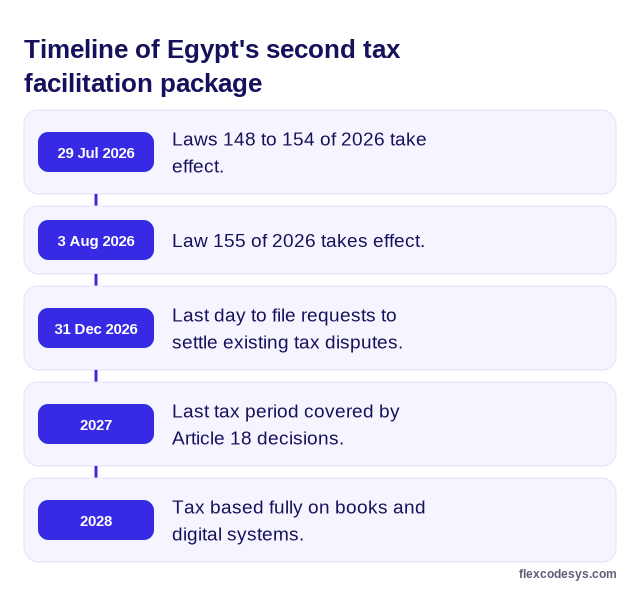
- Law 151 of 2026 repealed Article 18 of the Income Tax Law, and the head of the Egyptian Tax Authority (ETA) says tax will be based fully on books and digital systems from the 2028 tax period.
- Rules issued under Article 18 still apply to tax period 2027 and earlier, and Law 152 of 2026 allows requests to settle tax disputes until 31 December 2026.
- Use 2027 to make your books inspection-ready: close every month, reconcile with the ETA e-invoicing portal and keep a stock card for every item.
- Odoo provides the Egyptian chart of accounts, lock dates and the ETA e-invoicing link, while e-receipts from Point of Sale need to be confirmed with your partner.
In practice, the duty to keep books has applied since 29 July 2026, and 2027 is the last tax period still covered by the rules issued under Article 18. Use it to get your books, e-invoices, e-receipts and stock records into a state that will hold up in an ETA inspection. Odoo is a practical tool for doing exactly that.
What changed in bookkeeping requirements in Egypt?
According to a PwC tax alert, the package consists of eight laws, numbered 148 to 155 of 2026. Laws 148 to 154 were published in the Official Gazette (issue 30 bis A) on 28 July 2026 and took effect on 29 July, as the texts on the ETA website show. According to PwC, Law 155 was published on 2 August and took effect on 3 August, and a correction followed on 8 August 2026. EY reports that the package amends the Income Tax Law, the VAT Law, the Unified Tax Procedures Law, the Stamp Duty Law and the State Financial Resources Development Duty Law.
Three points matter most for your books. First, every taxpayer with a commercial, industrial, craft or professional activity must keep regular accounting records and books, under Article 38 of the Unified Tax Procedures Law as amended by Law 150 of 2026. Second, the same article allows books to be kept by hand or electronically. It does not mention e-invoices or e-receipts: those obligations come from separate ETA rules, so check with your adviser which apply to you. Third, the article applies without prejudice to Law 6 of 2025 for businesses with annual turnover up to EGP 20 million. This is relevant for businesses in the simplified regime.
What does the end of Article 18 and estimated assessment mean for your business?
According to the ETA head, Article 18 was the legal cover for instructions on net profit ratios and on estimated and lump-sum assessment. Law 151 of 2026 repeals it, while the rules issued under it stay in force for tax period 2027 and earlier. After that, expect your books to be the main evidence. If they are incomplete or do not match your e-invoice data, the gap will be visible, because the ETA already sees your invoices and receipts in its own system.
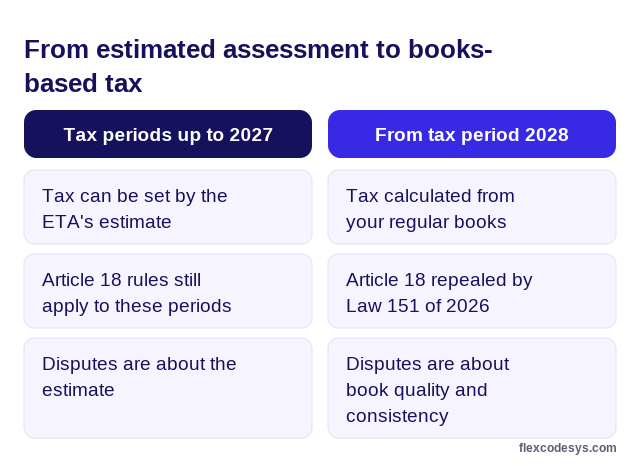
Note: The repeal of Article 18, with its rules staying in force for tax period 2027 and earlier, is in Article 6 of Law 151 of 2026. The bookkeeping duty without a turnover threshold is in Article 1 of Law 150 of 2026. Both were published in the Official Gazette on 28 July 2026. That tax will be based fully on books from 2028 is a statement by the ETA head as reported by Youm7, not wording of the law. Check the official text with your tax adviser before making final decisions.
Key dates from 2026 to 2028
On 19 November 2026 the ETA called on all taxpayers to register for e-invoicing and e-receipts, according to Al-Ahram. Support is available through hotline 16395 and the ETA guides for e-invoicing and e-receipts. The ETA has also signed a contract with E-Tax to build a platform for managing e-invoice and e-receipt cases, with follow-up and data analysis as stated aims, according to a Banker News report of 25 October 2026. Comparing your books with system data will only get easier for the authority.
How to prepare your books during 2027
The duty to keep books already applies, so treat 2027 as the year to make them inspection-ready. Work as if books-based taxation had already started, and find the gaps before they cost you money. A quick way to start is our ERP Readiness Check.
- Review with your tax adviser which estimated assessments or Article 18 decisions apply to your open years up to 2027, and whether any dispute should be filed for settlement before 31 December 2026.
- Close every month in the system: reconcile bank, cash, receivables and payables, then lock the period.
- Make sure every sales document is an accepted ETA e-invoice or e-receipt, and match your totals with the ETA portal each month.
- Keep a stock card for every item, since inspectors use it to compare sales against purchases.
- Attach supporting documents to each journal entry: vendor bills, contracts, employee custody and cash advances.
- If your companies or branches still run on spreadsheets, move them to one ledger and one chart of accounts in 2027, not in 2028.
- If you are in the simplified regime, check which simplified books you may keep instead of assuming full books are required.
If your data is split between an old accounting package and spreadsheets, a legacy ERP migration plan moves opening balances and open items without losing the audit trail.
How it works in Odoo
Ledgers and reports the inspector reviews
Odoo Accounting comes with an Egyptian fiscal localisation: a chart of accounts, preconfigured taxes for VAT and withholding tax, and journals for sales, purchases, bank and cash. In Odoo Enterprise, the Reporting menu gives you the general ledger, trial balance, partner ledger and aged receivables and payables, the books an inspection usually asks for.
Closing periods and preventing changes
Under Accounting > Accounting > Lock Dates (the path in the Odoo 19 documentation) you set lock dates that block changes to closed periods. A journal can also be set to secure posted entries with a hash, which restricts later changes to them. If you want to control who resets posted documents to draft and keep a record of it, the FlexCode Posted Document Control app adds a permission and an audit log for that step.
E-invoices and e-receipts
Odoo's Egyptian e-invoicing module sends invoices to the ETA and shows on each invoice whether the ETA accepted it, is still validating it or marked it invalid, so you quickly see which documents need correcting. Odoo's Egypt documentation covers e-invoicing only, so if you sell through Point of Sale, confirm with your partner how ETA e-receipts will be issued.
Inventory and the stock card
Odoo supports FIFO and average cost, with periodic or perpetual stock accounting. Agree with your accountant which method you use, so your warehouse balance matches the ledger. To print each item's movements as PDF or Excel the way inspectors expect, the FlexCode Stock Card Report app provides that report directly.
From the 2028 tax period, the ETA says tax will rest on your books, not on an estimate: make 2027 the year your books become defensible.
What to do now
- Meet your tax adviser before 31 December 2026 to review open years and existing disputes.
- Map where your books live today: paper, Excel, a local accounting package or an ERP system.
- From January 2027 at the latest, run one ledger, a monthly close and a monthly reconciliation with the ETA e-invoicing portal.
- Review progress in mid-2027 so you still have time to fix issues before 2028.
FlexCode Middle East in Cairo supports Egyptian companies with Odoo and the Egyptian localisation. Odoo implementation for small companies is part of our service plans, priced in EGP, and starting now leaves you most of 2027 to work with your new books. Begin with a free 30-minute ERP check and we will review where your books stand today.
Frequently asked questions
Are handwritten books still accepted after the amendments?
Yes. Article 38 as amended by Law 150 of 2026 allows books to be kept by hand or electronically. E-invoice and e-receipt obligations apply separately, and matching a paper ledger to ETA system data every month is slow and error-prone, which is why many businesses choose electronic books.
What is the temporary tax card?
It is a new measure in Law 150 of 2026 (Article 27 bis). On request, the ETA may grant a temporary tax card for eight months so that a business can complete its incorporation and licensing. The card cannot be used to issue e-invoices or e-receipts, and the head of the ETA issues a decision on its form, data and validity.
Does anything change if I am in the simplified tax regime?
The general bookkeeping obligation applies without prejudice to Law 6 of 2025, as Law 150 of 2026 states. Confirm with your adviser which simplified books apply to you. A vendor article quoting the ETA head has also linked the simplified regime's benefits to compliance with e-invoicing and e-receipts.
What happens to Article 18 assessments that were already issued?
Under Article 6 of Law 151 of 2026, the rules issued under Article 18 stay in force for tax period 2027 and earlier. If you have an open dispute, Law 152 of 2026 allows settlement requests to be filed until 31 December 2026, as EY also reports.
Do I need Odoo Enterprise for Egyptian e-invoicing?
Not for the modules themselves: the Egyptian localisation (l10n_eg) and the ETA e-invoicing module (l10n_eg_edi_eta) are part of Odoo's open-source Community code. The accounting reports described above belong to Odoo Enterprise, and its cost depends on the number of users and apps, so ask your partner to confirm what your edition covers.
This article is also available in: العربية
FlexCode configures Odoo for your business
We fit the system to your workflows and train your team. FlexCode Middle East in Cairo, part of an Odoo Silver Partner.