The UAE Ministry of Human Resources and Emiratisation (MoHRE) has asked private companies with 50 or more employees to meet their 2026 Emiratisation targets before the final deadline of 31 December 2026. Companies need a further 1% growth in Emiratis in skilled jobs in the second half of the year, on top of the growth achieved in the first half. For owners and finance leads, the practical questions are: do we meet the target, can we prove it with numbers, and what will a shortfall cost?
FlexCode Middle East is part of FlexCode Systems GmbH, an Odoo Silver Partner. We implement Odoo, and our own apps are mentioned where they fit.
Key points
- According to Sharjah24 and Al Khaleej, MoHRE has asked UAE private companies with 50 or more employees to meet their 2026 Emiratisation targets by 31 December 2026.
- According to Vivos Group, the ratio is measured against skilled roles only, not total headcount.
- MoHRE requires genuine employment, registration with the pension and social insurance systems, and wages paid through the approved systems, as reported by UAE Barq.
- Emirates 24|7 reports a contribution of AED 10,000 a month for each Emirati not hired, which you should confirm with MoHRE before you budget for it.
- Odoo can report your Emiratisation ratio as at any date, provided nationality, skill level and hire and departure dates are recorded correctly.
The answers sit in your HR and payroll data: the number of skilled positions, each employee's nationality, salaries paid through the Wage Protection System (WPS), and pension registration. This article sets out what is confirmed, what is not, and how to get these figures out of Odoo before year end.
What are the UAE Emiratisation targets for 2026?
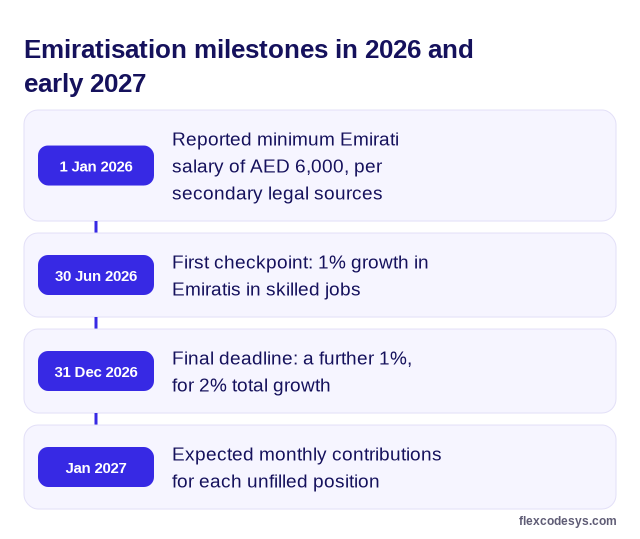
As reported by Sharjah24 and Al Khaleej on 30 October 2026, MoHRE called on companies with 50 or more employees to achieve 1% growth in Emiratis in skilled roles during the second half of 2026, bringing total growth for the year to 2%. UAE Barq confirmed on 4 November that 31 December is the final deadline.
According to Khaleej Times and the consultancy Vivos Group, these companies raise their Emirati share by 2% a year, reaching 10% by the end of 2026. Vivos Group gives two checkpoints this year, 30 June and 31 December, and says the ratio is measured on skilled roles, not total headcount.
Who counts towards your Emiratisation ratio?
According to UAE Barq, MoHRE requires the companies concerned to employ Emiratis genuinely, register them with the pension and social insurance systems, and pay their wages through the country's approved systems. MoHRE also directs companies to the Nafis platform to find candidates.
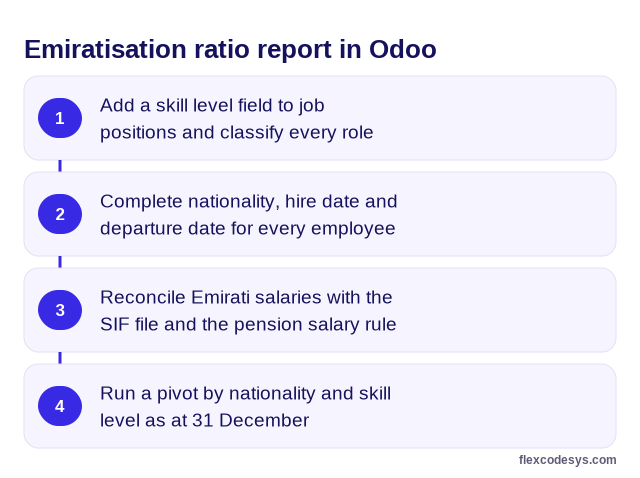
So the first step is to fix the denominator: a list of every skilled position in the company, based on MoHRE's skill level classification. Unskilled roles are excluded, which means your real ratio can differ a lot from the share of Emiratis in your total workforce. Then check each Emirati employee's record against the list below. It is our practical reading of these requirements, not an official MoHRE checklist:
- A valid MoHRE work permit issued under your company.
- Salary paid monthly through WPS and visible in the payroll file.
- Registration with the General Pension and Social Security Authority (GPSSA) or the emirate's own pension fund.
- A salary of at least AED 6,000 a month, the minimum for Emiratis in the private sector since 1 January 2026 according to Yomly and Vivos Group. The MIR DXB PRO guide states that from 1 July 2026 Emiratis paid less are left out of the count.
- A real job with duties and attendance, classified as a skilled role.
- A hire date before 31 December 2026, with no departure date before it.
What is the Emiratisation fine for missing the 2026 target?
MoHRE charges a monthly financial contribution for each Emirati position that is not filled. The MIR DXB PRO guide states that companies that missed the 30 June checkpoint have paid contributions since 1 July 2026, and that companies with 20 to 49 employees in 14 sectors named by MoHRE follow their own rules. Vivos Group describes the same group, but both are unofficial sources, so verify the rules with MoHRE if your company falls into it.
Note: Emirates 24|7 reported on 29 June 2026 that the ministry set the contribution at AED 10,000 a month (AED 120,000 a year) for each Emirati not hired, applied from 1 July. Vivos Group and MIR DXB PRO give the same figure, while some older articles still quote lower amounts from earlier years. We could not open MoHRE's website to confirm it, so check mohre.gov.ae before you put the figure into your budget or provisions.
Do not try to close the gap with paper hires. MoHRE requires genuine employment, and fictitious Emiratisation does not count and exposes the company to penalties. For finance, if you expect a remaining shortfall in January 2027, treat it as an expected expense or a provision in the year-end close, in agreement with your auditor.
How to calculate your Emiratisation ratio in Odoo
In Odoo 18, 19 and 20, most of the data you need already sits in the Employees and Payroll apps. Some field locations differ between versions, so check them on your own database.
Employees app: nationality and job position
On the employee form in Odoo 18, Nationality is under Private Information, and Job Position and Department are under Work Information. The Odoo 19 documentation names these tabs Personal and Work, so the labels differ by version. What standard Odoo does not have is a field for the MoHRE skill level of a role. You can add it to the job position with Odoo Studio in Enterprise, or with a small custom module in any edition. With that field in place, Odoo knows which roles belong in the denominator.
Payroll and the WPS file
The UAE payroll localisation in Odoo produces the SIF file for WPS. The wage on the employee's contract shows whether an Emirati salary reaches the reported minimum. The pension contribution for UAE nationals should be a salary rule in the payroll structure: confirm that the localisation on your version covers it, and take the rates directly from GPSSA.
The ratio report as at 31 December
In the Employees app, use the list or pivot view grouped by nationality and skill level. Hire and departure dates, or contract versions, let you run the report as at 31 December. Save it as a favourite filter or add it to a management dashboard.
Emiratisation evidence: which data you need and where it lives in Odoo
| Data point | Where in Odoo | Comment |
|---|---|---|
| Nationality | Employees: Private Information (Odoo 18) or Personal (Odoo 19) | Standard field |
| Skilled role | Job Position | Extra field via Studio or a custom module |
| Monthly salary | Employee contract | Compare with the reported minimum |
| Payment via WPS | Payroll: SIF file | From the UAE payroll localisation |
| Pension contribution | Salary structure: salary rule | Check coverage on your version |
| Service dates | Employee or contract | Needed for the 31 December report |
What to do before the Emiratisation deadline
- Count your skilled positions today, then the number of Emiratis your target requires.
- Check each Emirati's record against the checklist above and exclude anyone who does not qualify.
- Work out the gap before mid-December, because hiring and registration take time.
- If a gap remains, set up a provision for contributions after confirming the amount on MoHRE's website.
- After 31 December, archive the year-end report as evidence and follow MoHRE for new rules; according to Vivos Group, no general 2027 targets had been published at the time of writing.
An Emiratisation ratio you cannot prove from your own data is not much better than one you have not reached.
If you are unsure whether your data is ready, start with the ERP Readiness Check. The FlexCode Middle East team in Cairo can set up the fields and reports as part of our Odoo implementation service. Book a free 30-minute ERP check to review your position before year end.
Frequently asked questions
Does Odoo send Emiratisation data to MoHRE automatically?
No. Standard Odoo has no direct connection to MoHRE systems. As far as we know, MoHRE works from its own records, such as work permits, wage payments and pension registration. Odoo's role is to let you reconcile your internal data with those records and spot differences before the ministry does.
Do I need Odoo Enterprise to add a skill level field?
Odoo Studio is available only in Enterprise. In Community, the field can be added with a small custom module, which also works in Enterprise if you prefer not to depend on Studio.
What happens if an Emirati employee leaves in December?
A departure lowers your Emirati count. The MIR DXB PRO guide, an unofficial source, reports that a reduced count must be replaced within two months or contributions apply, so confirm the rule with MoHRE. Record departures as soon as they happen and rerun the report as at 31 December to see whether your gap has grown.
Are there Emiratisation targets for 2027?
According to Vivos Group, MoHRE had not published general targets for 2027 at the time of writing. Check MoHRE's website early in the year and keep your Odoo report ready for any new ratio.
This article is also available in: العربية
FlexCode configures Odoo for your business
We fit the system to your workflows and train your team. FlexCode Middle East in Cairo, part of an Odoo Silver Partner.